

 Search
Medically reviewed by Peter Nagele, MD, MSc and Ronald L. Harter, MD, FASA, July 18, 2025.
Ketamine
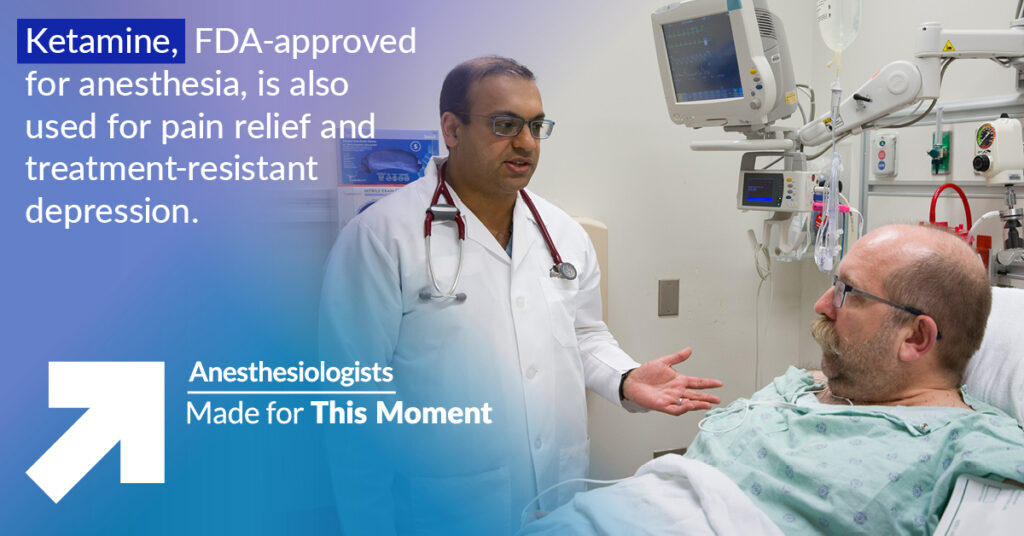
Ketamine is a medication approved by the U.S. Food and Drug Administration (FDA) for use as an anesthetic to prevent pain during surgery and other medical procedures. It belongs to a class of drugs called “dissociative anesthetic hallucinogens” that can make you feel separate from your body and surroundings.
Physicians also sometimes use ketamine to treat conditions such as chronic pain and depression, although it is not officially approved for these uses. This type of use, called “off-label,” is legal. However, if ketamine is used incorrectly and without medical supervision, it can be unsafe. Learn when and how to use ketamine so you can benefit from its use and stay safe.
Is ketamine used for general anesthesia in surgery?
It is uncommon for anesthesiologists to use ketamine as the primary medication for general anesthesia. High doses of ketamine can make patients see things that aren’t there (hallucinations), raise their blood pressure, and cause other unwanted effects. Because of these side effects, anesthesiologists prefer medications such as propofol for general anesthesia.
On rare occasions—for instance in trauma or for burn patients—anesthesiologists may use ketamine as the primary anesthetic for surgery. Ketamine may be safer in such cases because it can provide pain relief and make the patient unaware of the surgery, while typically maintaining the patient’s heart rate and blood pressure. When anesthesiologists use ketamine for general anesthesia, they may also give an anxiety-reducing drug through an IV to help prevent hallucinations and paranoia.
Ketamine is more frequently used for simpler procedures that require short-term sedation or anesthesia, such as dental procedures or treatment of burns.
How is ketamine used to relieve acute pain after surgery?
Anesthesiologists often include ketamine as one of the anesthesia medications they give to a patient during surgery to help reduce and manage pain after surgery. When used for this purpose, ketamine is given in smaller doses than would be needed for general anesthesia. These smaller doses don’t usually cause hallucinations or other significant side effects. Using ketamine in this way helps reduce or eliminate a patient’s need to take opioids for pain relief after surgery.
Can I use ketamine to reduce or relieve my chronic pain?
Yes, physicians sometimes prescribe ketamine to help treat chronic pain, especially when other treatments haven’t helped. It’s most often used to treat nerve-related pain. If you try ketamine for chronic pain, you should:
- Only use it under the care of a physician with expertise and training in pain medicine. Some anesthesiologists are pain medicine specialists. They are familiar with ketamine’s effects and can help ensure that you use the drug properly and safely.
- Use it as part of a broader treatment plan that might include things like physical therapy and lifestyle changes. Work with your prescribing physician to identify other health care professionals who can contribute to the development of your treatment plan.
Is ketamine effective for treating depression?
Ketamine has been well studied for use in people with depression who have tried at least two other antidepressant medicines without getting better (a condition referred to as treatment-resistant depression). Many studies show that ketamine can help some people with this kind of depression.
Though ketamine is not FDA-approved to treat depression, it can be used off-label for this purpose. But it must be administered by a physician.
The physician usually administers ketamine through an IV infusion into the bloodstream during sessions that last about 40 to 60 minutes. Less commonly, you can receive ketamine as a shot into a muscle. Because ketamine can have strong side effects, you should always receive it in a controlled setting like a hospital or clinic, where a physician can continuously monitor you.
A nasal spray that uses esketamine—one of the two molecules in ketamine—is FDA-approved for treatment-resistant depression. It is sold under the brand name Spravato in the United States. Because of possible side effects, you must take Spravato under the supervision of a health care professional at a certified Spravato treatment center. You are monitored for two hours after using the spray.
Is ketamine covered by insurance?
When ketamine is used for off-label purposes, such as treatment for pain or depression, insurance may not pay for it. Spravato is FDA-approved, so it is more likely to be covered by insurance than ketamine is. However, you should check with your insurer and physician to learn about your out-of-pocket costs before using ketamine or Spravato.
What are the risks of using ketamine?
Ketamine is a potent drug with many health risks. It can be dangerous if not used correctly; it can also be addictive. It can raise your blood pressure and heart rate, and it can cause confusion, agitation, delirium, and hallucinations. Using too much ketamine, or using it with other potent sedative medications, can also cause dangerous and even deadly breathing problems, seizures, or heart attacks.
These risks are greater if you take ketamine outside of a health care setting, where no one with the proper training is available to help you if problems occur. To protect yourself, you should receive ketamine only in a monitored setting under the care of a licensed health care professional. Rescue equipment must be immediately available.
In addition, ketamine should always be:
- Prescribed by an appropriately trained and licensed medical professional.
- Used as part of a comprehensive and clearly defined treatment plan when taken for pain management.
- Given at the lowest dose necessary for the medication to be effective.